Local inspection
Affected areas and mold condition documented in Spain.


A multi-cavity injection mold built in China developed flash during early European production. ITM diagnosed and repaired the tool locally while the original manufacturer retained the technical decision, warranty authority and customer relationship.
Discuss a similar caseAfter approximately 100,000 parts, flash appeared in several cavities. Previously repaired core-steel areas showed localized damage, creating an unacceptable condition before higher production volumes.
Multi-cavity injection mold built by a Chinese manufacturer and operating in Spain.
Flash in several cavities linked to localized damage in previously welded areas.
Limited production buffer and an approaching ramp-up made lead time important.
The Chinese manufacturer authorized the inspection and retained approval of the repair route.
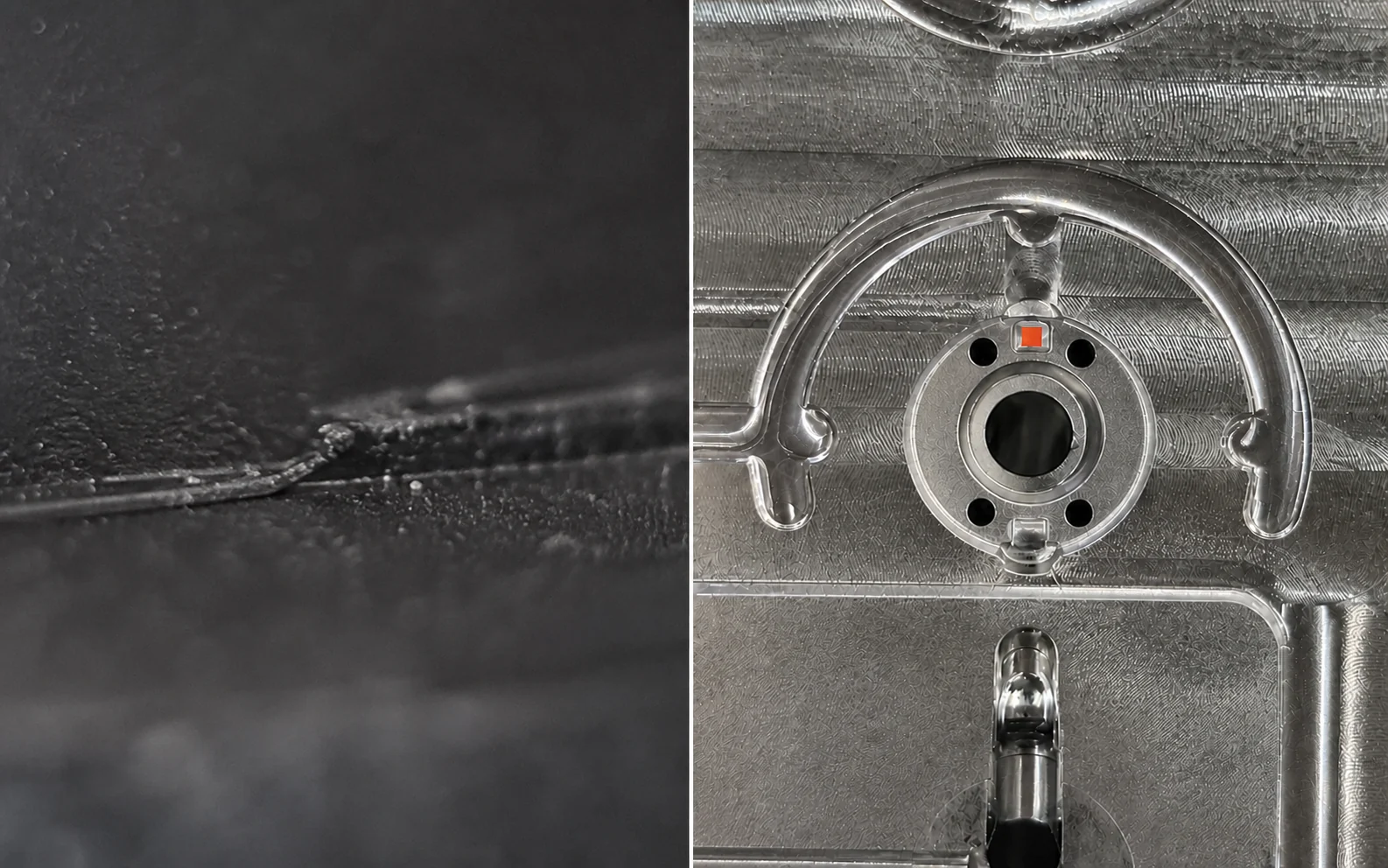
The visual has been anonymized and is illustrative of the documented technical condition. It is not a dimensional inspection record.
ITM did not take over the warranty decision. It converted the local findings into two technical alternatives for the manufacturer to assess.
Affected areas and mold condition documented in Spain.
New inserts were compared with localized welding and remachining.
Lead time, cost, durability and technical risk were made explicit.
The original moldmaker selected the faster, lower-cost welding route.
The selected route was translated into an internal workshop plan with defined operations and boundaries.
Relevant components were removed before welding and the affected areas were prepared for controlled local repair.
Localized welding was followed by EDM re-machining to restore the required geometry and surface finish.
Other observations not affecting part quality or tool operation were reported separately rather than added without approval.
ITM prepared and shared photographic and video evidence of the completed repair with the original manufacturer and the European customer team.
The European customer confirmed acceptance directly to the original mold manufacturer, preserving the manufacturer-led communication and approval process.
The mold remains in operation with no recurrence of the reported problem.
Follow-up status confirmed on 7 August 2026. No quantified post-repair cycle or production-volume claim is made.
The case demonstrates the SLTP model in practice: the Chinese moldmaker remained the supplier and decision-maker; ITM provided local diagnosis, repair capability, execution evidence and technical continuity in Spain.
Explore the Warranty service model →Send the technical situation. ITM and your team will compare the feasible routes before any corrective work is authorized.